A vacuum hose looks small, but it can influence how an engine breathes, calculates load, and controls fuel. In modern vehicles, these flexible lines connect intake manifolds with sensors, PCV systems, turbo controls, brake boosters, and emission components. A loose clamp or softened hose may allow air to enter where the engine computer does not expect it.
Why do vacuum hoses impact engine efficiency? The answer begins with air measurement. When a hose leaks, the engine can receive unmetered air and develop an incorrect air-fuel mixture. Drivers may notice rough idling, delayed acceleration, higher fuel consumption, or a faint hissing sound near the intake. Sometimes, the check-engine light remains off, which makes the problem easier to overlook. Small faults can hide.
Choosing the 2026 best vacuum hoses requires more than selecting the thickest product. Material compatibility, temperature resistance, oil exposure, inner diameter, flexibility, and connector fit all matter. Silicone hoses may tolerate heat well, while reinforced rubber can offer dependable flexibility for many factory applications. However, neither material is automatically correct for every circuit. The vehicle manufacturer’s specifications remain the most reliable reference.
A careful inspection should include cracks, swelling, hardened ends, collapsed sections, and loose fittings. Compare the replacement hose with the original length and routing. Avoid sharp bends.
This guide examines hose materials, fitting accuracy, durability, installation quality, and real-world engine symptoms. It also recognizes an uncomfortable truth: a premium hose cannot repair poor routing or an unresolved intake problem. Reliable results come from matching the part to the system, then verifying engine operation after installation.
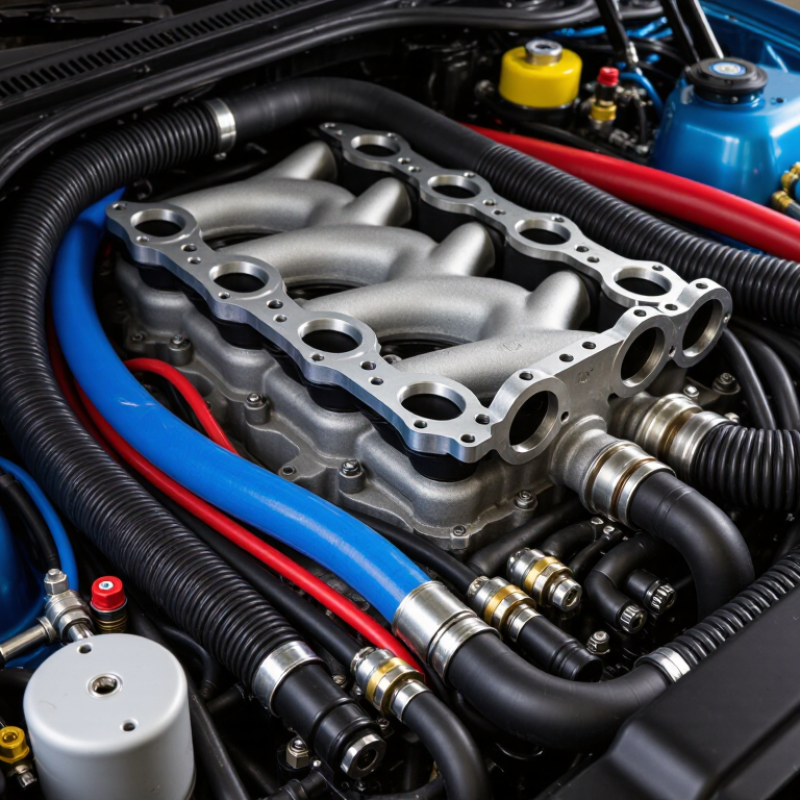
What Vacuum Hoses Are and How They Support Engine Systems
Vacuum hoses are small lines with a large responsibility. They carry negative pressure between the intake manifold and control devices. These devices include the brake booster, fuel-pressure regulator, evaporative-emissions system, and turbocharger actuator.
A healthy hose keeps pressure signals stable. That stability helps the engine control fuel delivery, ignition timing, and air management. When a hose splits, the engine may draw unmetered air through a tiny crack. The result can be rough idling, delayed acceleration, higher fuel use, or a warning light. The U.S. Environmental Protection Agency’s 2024 Automotive Trends Report shows that fuel efficiency remains a major engineering target. A minor vacuum leak can quietly undermine that target.
Small leaks matter.
Professional diagnostic guidance commonly uses fuel-trim readings near ±10% as a practical screening point. Higher positive trim may suggest extra air entering the engine. SAE service literature also emphasizes checking vacuum integrity before replacing electronic components. That approach saves parts, time, and unnecessary expense.
Inspect hoses when the engine is cool. Look for flattened sections, glossy heat damage, loose clamps, and oil-softened rubber. Gently flex the hose near each connector. Some failures hide underneath, where the surface looks normal.
I have found that visual checks alone are not enough. A smoke test can reveal a pinhole that idle speed barely exposes. Hose design, routing, and material quality also matter, yet maintenance schedules often overlook them. That is an uncomfortable gap in otherwise careful engine care.
How Vacuum Hoses Influence Airflow and Engine Efficiency
2026 Best Vacuum Hoses: Why Do They Impact Engine Efficiency?
Vacuum hoses look simple, but they control important airflow signals. They connect the intake manifold with systems such as crankcase ventilation, brake assistance, and vapor control. A cracked hose can admit unmetered air after the airflow sensor. The engine then receives more oxygen than the control system expects. Fuel correction may rise, idle speed can hunt, and combustion becomes less stable. On engines using manifold-pressure sensing, a weak vacuum signal can also distort calculated engine load. That affects ignition timing, fuel delivery, and sometimes automatic transmission behavior. Small hose, noticeable consequences.
Material choice matters during replacement. Heat near the cylinder head can harden ordinary rubber quickly. Oil mist can swell unsuitable tubing, while a loose clamp may create an intermittent leak. A technician should inspect soft spots, surface cracks, collapsed bends, and oily connections. A smoke test is usually more dependable than listening for a hiss. Not every rough idle is a hose fault. That assumption deserves restraint.
The 2024 Fuel Economy Guide from the U.S. Environmental Protection Agency and Department of Energy reports that aggressive driving can reduce fuel economy by 15–30% on highways and 10–40% in stop-and-go traffic. Those figures do not isolate vacuum-hose failures, but they show how strongly airflow and engine control affect efficiency. SAE technical literature on intake-leak diagnosis similarly treats unmetered air as a measurable calibration problem, not merely a maintenance annoyance. Correct diameter, temperature resistance, and secure routing remain more important than appearance.
2026 Best Vacuum Hoses: Why Do They Impact Engine Efficiency?
How vacuum hoses influence airflow and engine efficiency
Estimated pressure loss across a 1-meter smooth hose carrying 300 L/min of air at approximately 20°C. The values are based on the Darcy–Weisbach airflow model. A larger internal diameter reduces airflow resistance, helping vacuum-operated engine systems respond more consistently and minimizing energy losses.
Key Signs of Damaged or Failing Vacuum Hoses
A damaged vacuum hose can quietly reduce engine efficiency long before a warning light appears.
In workshop inspections, I often notice a sharp hissing sound near the intake system. The noise may rise when the engine idles. A rough idle, delayed acceleration, difficult starting, or an unusually high idle speed can also indicate a vacuum leak. These symptoms are easy to blame on fuel or ignition problems.
Look closely.
Cracked rubber, brittle surfaces, loose fittings, and flattened sections are common warning signs. Oil exposure can make some hoses swollen and soft. Others become hard enough to split when moved. A failing hose may also cause lean combustion readings, poor fuel economy, or occasional stalling. It can be surprisingly subtle. A hose may appear acceptable until the engine warms up and the material expands.
Check hoses with the engine off and cool, then trace each connection carefully. Do not pull aggressively around fragile fittings. A professional smoke test can reveal leaks that visual inspection misses. If a hose serves the brake-assist system, a firm pedal requires immediate attention. I have replaced hoses that looked only slightly aged, yet the idle improved afterward. Still, replacing every hose without testing is wasteful and can hide another fault. Good diagnosis requires patience, accurate measurements, and a willingness to question the first assumption.
How to Choose the Best Vacuum Hose for Your Engine
Choosing the best vacuum hose starts with fit, not appearance. Measure the inner diameter with calipers, then match the original routing and connector size. A hose that feels tight may still collapse under high vacuum. SAE material guidance emphasizes temperature resistance, oil exposure, and compression-set performance, all important near hot engine parts.
Check the engine’s temperature range and vacuum rating. Use reinforced hose for long runs, sharp bends, or high-vibration areas. Silicone can tolerate heat, but it may resist oil less effectively than specialized rubber compounds. The U.S. Environmental Protection Agency’s OBD requirements use emissions fault thresholds near 1.5 times applicable limits, showing why small intake leaks deserve attention. A cracked hose can create lean mixtures, unstable idling, and incorrect fuel trims.
Inspect the hose cold and warm. Look for shiny collapse marks, hardened ends, surface cracks, and loose clamps. Replace damaged clips too. I have found that routing matters almost as much as material; a perfect hose can fail against a bracket edge. Do not rely only on color or softness. Some hoses feel strong but flatten during acceleration. A smoke test can confirm hidden leaks, although testing results can be imperfect when the engine has several aged connections. Keep the original length unless the manufacturer specifies otherwise. Too short creates tension; too long creates kinks.
2026 Best Vacuum Hoses Why Do They Impact Engine Efficiency? - How to Choose the Best Vacuum Hose for Your Engine
Vacuum Hose Selection and Engine Efficiency Guide
| Hose Type |
Typical Material |
Typical Temperature Range* |
Recommended Use |
Main Strength |
Common Limitation |
Efficiency Risk if Incorrect |
| General-purpose vacuum hose |
EPDM or vacuum-rated rubber |
Approximately -40°C to 150°C |
Brake booster, intake manifold, emission-control and control-system vacuum lines |
Good flexibility and abrasion resistance |
Not suitable for every fuel, oil or high-temperature location |
A split or collapsed hose can create a vacuum leak, unstable idle and incorrect air-fuel control |
| Silicone vacuum hose |
Silicone elastomer |
Often approximately -50°C to 200°C; verify the product specification |
High-temperature vacuum routing away from direct exhaust contact |
Wide temperature capability and good flexibility |
Some silicone compounds have limited resistance to oil and fuel vapors |
Softening, swelling or permeation can reduce vacuum stability and actuator response |
| Fluorosilicone-lined hose |
Fluorosilicone inner layer with silicone outer layer |
Commonly suitable for high-temperature service; exact limits vary by construction |
Locations exposed to oil mist, fuel vapor and elevated temperature |
Better chemical resistance than standard silicone |
Higher cost and may be less flexible than basic hose |
Chemical attack can cause cracking or loss of sealing at fittings |
| Nitrile vacuum hose |
NBR rubber |
Often approximately -30°C to 120°C; verify the formulation |
Oil-exposed areas and selected crankcase or vapor-control circuits |
Good resistance to petroleum-based oils |
Can age faster under ozone, sunlight and sustained high heat |
Hardening or surface cracks may allow unmetered air into the intake system |
| Reinforced vacuum hose |
Rubber or silicone with textile reinforcement |
Depends on the liner and reinforcement; use the specified rating |
Longer runs, high-vacuum circuits and applications where collapse is possible |
Better resistance to kinking and hose collapse |
Less flexible and may require more space for routing |
Restriction can reduce actuator movement or alter control-system vacuum levels |
| Formed molded hose |
Molded rubber or molded elastomer |
Application-specific; follow the marked or documented rating |
Complex factory-designed routing with fixed bends and branches |
Maintains the intended shape and clearance |
A straight replacement may kink or place stress on fittings |
Kinks, poor fit or a wrong branch layout can restrict airflow or cause leakage |
*Temperature ranges are typical material ranges, not universal ratings. Always confirm the hose specification for continuous temperature, vacuum, chemical exposure and installation conditions.
How Vacuum Hose Condition Affects Engine Efficiency
| Hose Problem |
What Happens in the Engine |
Typical Symptoms |
Efficiency Consequence |
Recommended Check |
| Crack or pinhole leak |
Air enters the intake system without being correctly measured by the engine-management system |
Rough idle, hesitation, lean fault codes or difficult starting |
Less stable combustion and possible increase in fuel consumption |
Inspect bends and ends; use a suitable smoke test when necessary |
| Collapsed or kinked hose |
Vacuum flow is restricted and the connected valve or actuator may not receive the designed signal |
Slow actuator response, boost-control problems or inconsistent operation |
Reduced control accuracy and possible loss of engine performance |
Check the entire route for tight bends, hot spots and unsupported sections |
| Hardened hose end |
The hose no longer seals securely around the fitting |
Intermittent idle changes, hissing or faults that appear after warm-up |
Unstable vacuum signals and inconsistent fuel correction |
Flex the hose gently and inspect for brittleness, looseness or surface damage |
| Oil- or fuel-damaged hose |
The material swells, softens or loses mechanical strength |
Loose connections, odor, visible swelling or repeated hose failure |
Leaks become more likely, reducing control-system reliability |
Choose a material rated for the actual fluid and vapor exposure |
Selection Checklist
- Match the inside diameter to the original fitting; a loose fit can leak and an undersized hose can restrict flow.
- Use hose rated specifically for vacuum service rather than ordinary fluid-transfer tubing.
- Confirm continuous temperature, oil or fuel-vapor exposure, ozone resistance and routing clearance.
- Use formed or reinforced hose where the original route contains sharp bends or collapse-prone sections.
- Secure connections with suitable clamps where required, while avoiding excessive tightening that can cut the hose.
Vacuum Hose Inspection, Maintenance, and Replacement Steps
Vacuum Hose Inspection, Maintenance, and Replacement Steps
Vacuum hoses quietly influence air-fuel control, idle quality, and engine response. I have found that small leaks often appear before warning lights do. Inspect hoses with the engine off and completely cool. Look for splits around bends, shiny hardened surfaces, soft sections, and loose connections. Oil residue deserves attention. It can weaken some rubber compounds over time.
Do not rely on sight alone. Gently flex each hose and listen for faint hissing after starting the engine. Keep hands, clothing, and tools away from moving parts. A vacuum gauge can support diagnosis, but readings require correct interpretation. A stable reading does not always prove every hose is healthy. That limitation is easy to overlook.
Replace damaged hose with material matching the original diameter, temperature range, and vacuum duty. Cut both ends square, then seat them fully over clean fittings. Avoid sharp bends, stretched sections, and contact with hot metal. Secure loose routing with suitable clips, not excessive force. After replacement, start the engine and check idle behavior, hose movement, and unusual sounds. Recheck the connection after a short drive. I once treated a loose fitting as a hose failure, which wasted time and taught me to inspect the entire route.
Conclusion
Vacuum hoses are flexible passages that carry engine vacuum to systems such as air control devices, fuel management components, and emission-related equipment. They help maintain the correct airflow balance, allowing the engine to regulate pressure and operate efficiently. Why do vacuum hoses impact engine efficiency? When a hose is cracked, loose, blocked, or incorrectly fitted, unmetered air may enter the system, disrupting the air-fuel mixture and forcing the engine to work harder. This can lead to rough idling, weak acceleration, increased fuel consumption, warning lights, or unusual hissing sounds.
Choosing the best vacuum hose requires matching the correct size, flexibility, temperature resistance, and material to the engine’s operating conditions. Regular inspection should include checking for brittleness, swelling, abrasions, leaks, and loose connections. During replacement, turn off the engine, identify each connection, remove the damaged hose carefully, compare the new hose with the original length, and secure it firmly without sharp bends. Routine maintenance helps preserve stable airflow, dependable engine performance, and long-term efficiency.

 TerraForge Machinery