How to Choose Reinforced Silicone Hoses for Cars in 2026?

Time:2026-10-01 Author:Mason
0%

Choosing the right hose can protect an engine from heat, pressure, and expensive roadside failures. For drivers asking, “How to choose reinforced silicone hoses for performance cars?”, the answer begins with real operating conditions. A polished showroom appearance is not enough. Under a modified bonnet, coolant temperatures can climb quickly. Boost pressure can also expose weak walls, poor fittings, and incorrect clamp tension.

Mike McGinnis, an automotive hose technical specialist, offers a practical reminder: “A reinforced silicone hose must be selected for the system, not simply for its color.” That principle matters in 2026, when performance cars use tighter engine bays, higher thermal loads, and increasingly complex cooling layouts. A reliable choice should match the required inner diameter, pressure rating, temperature range, and reinforcement structure. Check compatibility with coolant, oil mist, and nearby components. Some hoses look strong but soften after prolonged heat exposure.

Fitment deserves equal attention. Measure the original hose carefully. Inspect bends, outlets, and clearance around exhaust hardware. Avoid sharp kinks. Use smooth-radius designs where possible. Stainless-steel clamps should sit evenly behind the bead, never on the hose edge. Small details matter.

Real workshop inspections often reveal another problem: neglected hoses. Surface cracking may appear before a dramatic failure. Yet visual checks are imperfect. Internal separation can remain hidden. Therefore, replacement intervals should consider mileage, track use, heat cycles, and installation quality. Choosing premium reinforcement helps, but it does not correct poor routing. The best selection balances material quality, verified specifications, practical fitment, and honest maintenance habits. Performance is valuable. Dependability matters more.
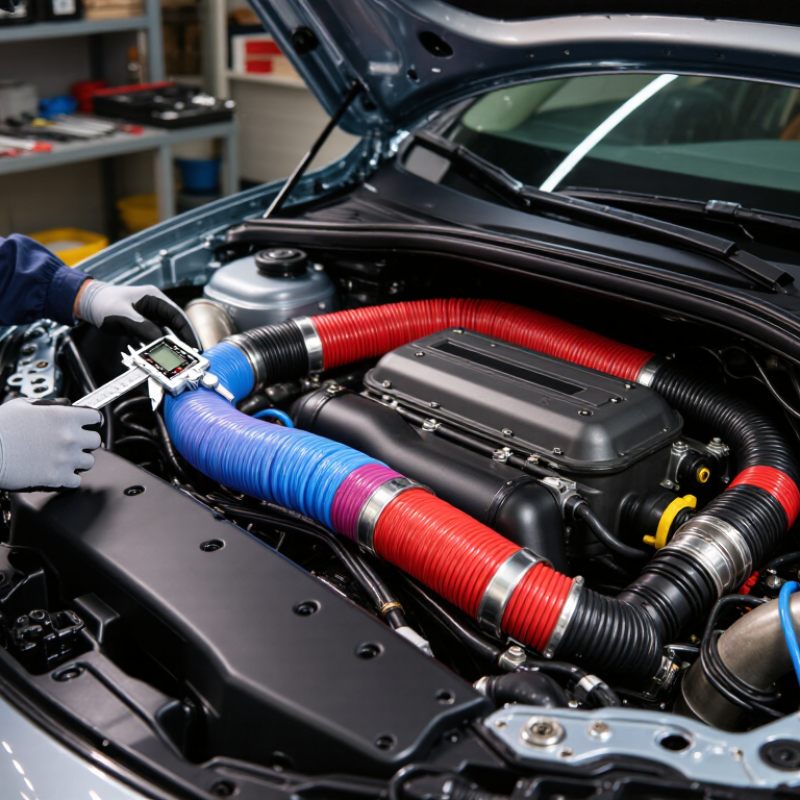
How to Choose Reinforced Silicone Hoses for Cars in 2026?

What Reinforced Silicone Hoses Are and How They Work in Cars

How to Choose Reinforced Silicone Hoses for Cars in 2026?

What Reinforced Silicone Hoses Are and How They Work in Cars

Reinforced silicone hoses are flexible fluid paths inside modern vehicles. They carry coolant, charge air, or vacuum between engine components. Silicone tolerates heat and remains flexible during cold starts. Embedded polyester, aramid, or wire layers add strength. These layers limit swelling under pressure and vibration. Without reinforcement, a soft hose may expand, weaken, or collapse.

Simple in theory.

When choosing a hose in 2026, match its intended fluid and operating temperature. Coolant hoses need resistance to heat, glycol mixtures, and repeated pressure changes. Air hoses need stable dimensions during turbocharger operation. Measure the inner diameter carefully. A loose fit can leak, while excessive stretching can damage the hose. Check the bend angle, wall thickness, and reinforcement pattern. Appearance alone proves little.

Installation matters. Clean the connection before fitting the hose. Push it beyond the raised sealing bead. Use suitable clamps, but avoid crushing the silicone wall. After installation, inspect for twisting, rubbing, and nearby exhaust heat.

One practical warning remains important. Many failures begin with poor routing, not poor silicone. I have seen a correctly sized hose fail because it touched a sharp bracket. Recheck it after the first heat cycle, since small movement can become serious wear.

How to Match Hose Materials with Automotive Temperature and Pressure

How to Choose Reinforced Silicone Hoses for Cars in 2026?

Choosing hose material starts with real temperature and pressure data. SAE J20 coolant-hose specifications cover high-temperature engine service, while ISO 1402 defines hydrostatic pressure testing. Typical coolant systems operate near 90–110°C, but turbocharger areas can expose hoses to over 150°C. That difference matters. Standard silicone usually handles heat well, yet it may soften under continuous oil contact. Fluorosilicone liners offer better resistance to fuel and oil, but they cost more and can feel less flexible.

Pressure also changes the choice. A reinforced hose with polyester fabric suits many coolant and air applications. Aramid reinforcement is stronger where boost pressure, vibration, and sharp temperature cycles overlap. Always compare the hose’s continuous rating, burst pressure, bend radius, and connector size. A hose that survives a short pressure spike may still fail after months of heat cycling. I have seen installation errors, not material defects, cause early leaks.

Tips: Measure the hottest nearby surface, not only coolant temperature. Leave room for engine movement. Check clamps after the first heat cycle. Do not trust appearance alone. SAE or ISO test evidence is more useful than a vague “high-performance” claim. Recheck the specification when engine tuning changes, because a small boost increase can expose a weak hose quickly.

How to Choose the Right Hose Size, Shape, and Reinforcement

Choosing reinforced silicone hoses for cars starts with accurate measurement, not visual guessing. Measure the inside diameter at the fitting, then check outside clearance nearby. A hose that is too narrow restricts flow and may overheat. A loose hose can leak after repeated pressure cycles. Use calipers when possible. Record measurements in millimeters. Temperature, coolant type, and working pressure should guide the final size. The largest-looking hose is rarely the safest option.

Shape matters when space is limited. A straight hose suits open engine bays, while elbows, reducers, and hump sections manage tight bends. Avoid forcing a straight hose around a sharp corner. Its inner wall can flatten like a pinched straw. Check the bend radius, connection angle, and nearby belts or hot exhaust parts. In my workshop experience, a small alignment error can create constant tension at the clamp. That mistake is easy to miss.

Reinforcement should match the application. Multiple fabric layers generally improve resistance to pressure, vibration, and collapse, but they can reduce flexibility. For high-heat or pressurized systems, choose construction rated for the actual conditions, with a sensible safety margin. Do not rely on thickness alone. Inspect the cut edge: fibers should appear evenly embedded, without gaps or loose strands. I once approved a hose that looked strong but kinked during installation. Rechecking the routing would have prevented it. Clamps should sit behind the bead, not on its edge.

How to Choose Reinforced Silicone Hoses for Cars in 2026?

Use the nominal inner diameter first, then match the hose shape and reinforcement to the vehicle system, temperature, pressure, and installation space.

1. Choose the Size

Measure the fitting outside diameter and select a hose with the matching nominal inner diameter. Common automotive sizes include 16, 19, 25, 32, and 38 mm.

2. Choose the Shape

Use straight hose for simple routing and molded elbows or hump sections where the engine layout requires controlled bends and movement absorption.

3. Choose Reinforcement

Silicone hoses commonly use polyester, aramid, or similar fabric reinforcement. Select the construction according to coolant, charge-air, vacuum, temperature, and pressure requirements.

Chart data shows common nominal hose inner diameters. Inch-to-millimetre equivalents use 1 inch = 25.4 mm; actual hose dimensions and pressure ratings vary by construction and application.

Which Silicone Hose Features Improve Durability and Vehicle Performance

How to Choose Reinforced Silicone Hoses for Cars in 2026?

Durability starts with the reinforcement layer, not the bright silicone surface. In workshop inspections, polyester braid works well for ordinary cooling systems. Aramid reinforcement handles higher pressure and tighter engine-bay temperatures. More layers are not always better. Extra thickness can reduce flexibility and complicate installation. A hose should bend smoothly without flattening near the clamp.

Temperature resistance directly affects vehicle performance. Choose a hose rated above the engine’s highest measured temperature, not just the average reading. Heat soak can continue after the engine stops. Check resistance to coolant, water, air, and mild chemical exposure. Silicone performs strongly with coolant, but it is not automatically suitable for every oil or fuel application. Always verify compatibility from technical data.

Correct dimensions matter as much as material quality. Measure the inner diameter carefully, because a loose fit can cause leaks and turbulence. A narrow bend may restrict coolant flow. Use rounded clamps with even pressure, and avoid overtightening. I once selected a hose by appearance alone, then found a small collapse behind the bend. That shortcut looked efficient, but it created unnecessary heat risk. Inspect the hose after installation, especially near sharp brackets and moving components. Five minutes can reveal a damaged braid, soft spot, or shifting clamp.

How to Choose Reinforced Silicone Hoses for Cars in 2026? — Which Silicone Hose Features Improve Durability and Vehicle Performance

Hose Feature Typical Selection Guidance How It Improves Durability Effect on Vehicle Performance What to Check Before Purchase
Reinforcement Fabric Choose multi-layer polyester reinforcement for common cooling and intake applications. Aramid reinforcement is useful where higher temperature stability or lower expansion is required. Controls hose expansion, helps resist bursting, and reduces deformation under pressure and heat. Maintains a more consistent internal diameter, supporting stable coolant flow, charge-air flow, and boost response. Confirm the reinforcement type, number of layers, pressure rating, and compatibility with the vehicle system.
Temperature Resistance Many automotive silicone hoses are designed for approximately -50°C to 180°C continuous service, with higher short-term limits depending on construction. Reduces hardening, softening, cracking, and loss of elasticity during repeated thermal cycles. Helps preserve sealing performance during cold starts, heavy traffic, towing, and high-load driving. Compare the continuous and peak temperature ratings with the actual coolant, turbocharger, or engine-bay temperature.
Inner-Layer Material Use a smooth silicone inner layer for coolant and air systems. Select a construction specifically rated for oil mist or fuel contact when required. A suitable inner layer limits swelling, surface deterioration, and permeability caused by fluids or vapors. A smooth bore reduces flow disturbance and helps maintain efficient air or coolant movement. Check resistance to coolant, water, air, oil mist, fuel vapor, and any cleaning chemicals used in the system.
Wall Thickness Select a wall thickness appropriate to the hose diameter, pressure, bend radius, and application rather than choosing the thickest option automatically. Provides resistance to collapse, abrasion, vibration, and localized compression. Helps prevent restriction under suction or tight bends, especially in intake and radiator connections. Verify inside diameter, outside diameter, minimum bend radius, and clearance from belts, pulleys, and hot components.
Shore A Hardness Automotive silicone hoses commonly fall around Shore A 60–80, but the correct hardness depends on flexibility, support, and pressure requirements. Balanced hardness helps resist kinking and fitting damage without making the hose excessively brittle or difficult to install. Supports stable routing and reduces the chance of flow restriction caused by sharp deformation. Choose a hose that can seal securely while still accommodating engine movement and vibration.
Pressure Rating Use a pressure rating that exceeds the system's maximum working pressure, including pressure spikes and temperature effects. Reduces the risk of ballooning, burst failure, and clamp pull-off. Maintains consistent boost-air delivery and reliable coolant circulation under demanding conditions. Check working pressure at the intended temperature; never rely on a room-temperature rating alone.
Vacuum-Collapse Resistance For suction-side intake or coolant applications, select a hose with suitable vacuum resistance or install an appropriate internal support spring. Prevents the hose from flattening repeatedly, which can cause fatigue cracks and permanent deformation. Preserves airflow and coolant flow when the engine operates at high speed or under strong suction. Confirm vacuum performance for the hose size and routing, especially near the turbocharger inlet or water-pump suction side.
Abrasion and Ozone Resistance Choose a reinforced hose with a durable outer silicone surface when it will contact brackets, wiring, or other components. Helps resist rubbing, ultraviolet exposure, ozone cracking, and damage from engine-bay vibration. Reduces the likelihood of leaks that can cause overheating, intake-air loss, or reduced boost pressure. Inspect the installation path and add protective sleeving or spacers where rubbing cannot be eliminated.
Connection and Clamp Compatibility Match the hose inside diameter to the pipe outside diameter and use clamps suitable for silicone hose surfaces. Correct fit and even clamping reduce leakage, cutting, extrusion, and clamp-related damage. Maintains system pressure and prevents unmetered air or coolant loss. Avoid over-tightening; check bead depth, clamp position, surface condition, and retightening requirements after heat cycling.
Dimensional Stability Prefer hoses with low expansion and consistent dimensions across the expected temperature and pressure range. Reduces stress at fittings and limits fatigue caused by repeated expansion and contraction. Supports stable boost pressure, predictable throttle response, and consistent cooling-system flow. Review expansion data, dimensional tolerances, and the hose's intended application instead of judging quality by appearance alone.
Routing and Bend Radius Use formed elbows or correctly sized couplers where a sharp bend would exceed the hose's minimum bend radius. Prevents kinks, crease fatigue, localized overheating, and stress concentration at connection points. Maintains the designed flow area and minimizes unnecessary pressure loss. Measure the route with the engine in its normal position and allow clearance for movement, heat, and service access.
Quality and Traceability Information Select products with clear dimensions, temperature limits, pressure data, material information, and application guidance. Documented specifications make it easier to match the hose to its operating environment and replace it correctly. Correct specification reduces installation errors that may cause leaks, restrictions, or premature failure. Request test information or technical documentation when the hose will be used in high-temperature, high-pressure, or racing conditions.

Note: Temperature, pressure, chemical-resistance, and service-life figures vary with hose diameter, reinforcement, wall construction, fittings, and operating conditions. Always verify the product-specific specifications before installation.

How to Inspect, Install, and Maintain Reinforced Silicone Hoses in 2026

In 2026, reinforced silicone hoses remain useful for coolant, intake, and vacuum systems. Choose a hose with the correct inner diameter, temperature range, pressure rating, and reinforcement structure. Never assume a thicker wall suits every application. Check the vehicle service manual and the hose supplier’s technical data. Silicone is not automatically suitable for fuel or oil. Confirm chemical compatibility before installation.

Inspect the hose when the engine is cold and the system holds no pressure. Look for cracks, bulges, soft sections, flattened bends, abrasion marks, and oil contamination. Flex the hose gently. A sticky surface or hidden split deserves replacement. Examine the fittings and clamps too. Rusty clamps can cut through the outer layer. I prefer a clean, square cut, but even careful work can leave a small edge. Recheck it before fitting.

During installation, clean each connection and push the hose fully over the fitting bead. Keep the hose away from exhaust heat, sharp brackets, and moving belts. Do not twist it to correct poor alignment. Use suitable clamps and tighten them evenly, without crushing the reinforcement. After installation, run the engine until warm and inspect for leaks. Let it cool, then check again. This second inspection is easy to skip, yet heat changes hose movement and clamp tension. Replace damaged hoses promptly, and record inspection dates during routine servicing.

FAQS

What are reinforced silicone hoses used for in cars?

They carry coolant, charge air, or vacuum between engine components. Reinforcing layers resist swelling, collapse, vibration, and pressure changes. Simple, but important.

Why does silicone work well during engine temperature changes?

Silicone stays flexible during cold starts and tolerates high temperatures. However, it is not automatically suitable for fuel or oil. Check compatibility.

How should I choose the correct hose size?

Measure the inner diameter at the fitting with calipers. Record millimeters. A narrow hose restricts flow, while a loose hose may leak.

Does a thicker hose always provide better performance?

No. Thickness alone proves little. Reinforcement, temperature rating, pressure rating, and flexibility must match the application. A thick hose can still kink.

Which hose shape suits a crowded engine bay?

Use elbows, reducers, or hump sections when space is tight. Do not force a straight hose around a sharp corner. It may flatten like a pinched straw.

How can I install a reinforced silicone hose safely?

Clean the fitting and push the hose beyond the raised sealing bead. Place the clamp behind the bead. Tighten evenly, without crushing the wall.

What should I inspect after installing the hose?

Check for twisting, rubbing, leaks, and contact with exhaust parts or moving belts. Run the engine warm, inspect again, then recheck after cooling.

When should a reinforced silicone hose be replaced?

Replace it for cracks, bulges, sticky surfaces, flattened bends, abrasion, hidden splits, or oil contamination. Inspect while cold and unpressurized. Do not delay.

Conclusion

Choosing the right reinforced silicone hose is essential for reliable automotive cooling, turbocharging, intake, and fluid systems in 2026. These hoses use silicone layers supported by fabric reinforcement, allowing them to handle higher temperatures, pressure fluctuations, vibration, and engine movement than standard rubber hoses. To select the correct option, compare the hose’s temperature and pressure ratings with the vehicle’s actual operating conditions. Then confirm the inner diameter, length, bend angle, wall thickness, and reinforcement type to ensure proper fit without sharp bends, stretching, or flow restrictions. How to choose reinforced silicone hoses for performance cars? Focus on heat resistance, pressure stability, flexibility, and compatibility with coolant, air, oil, or other approved fluids.

Durability and vehicle performance also depend on smooth inner surfaces, strong connections, and resistance to aging, abrasion, and ozone. Before installation, inspect the hose for cracks, deformation, or contamination, and use suitable clamps without overtightening. During maintenance, check for leaks, soft spots, swelling, and loose connections, especially after high-temperature driving. Replacing worn hoses promptly helps protect engine systems, maintain efficient airflow and cooling, and support dependable long-term performance.

Mason

Mason

Mason is a seasoned marketing professional with a deep expertise in the company's offerings and a passion for driving brand awareness. With a strong background in digital marketing strategies, he has an innate ability to connect with diverse audiences and effectively communicate product benefits.......